
It’s that time of the year when festivities gallop from the kitchen to the living rooms in a matter of seconds, happy vibes chase the wind from the choral harmonies to the commoners on the streets, and traditions lift their hearts to the modern social and cultural spreads. I ran a little detour to explore the rich evolution and diversity of the traditional Christmas components. We’re drifting down centuries, as well as hopping around a few countries, soaking in the festive spirit. Read on!
Conversing and Carolling
Many carols we call ‘traditional’ are actually conversations and improvisation across centuries. ‘Carol’ originates from the Old French word ‘carole’, a circle dance accompanied by singers. Carols, in the way we know them today, haven’t always had a religious connotation or a Christmas affiliation. They date back thousands of years, to pre-Christian / Pagan songs, written and sung for winter solstice celebrations. The winter solstice—the shortest day of the year in the Northern hemisphere usually falls on or around the 21st of December. Carols would be written and performed to celebrate all the four seasons in a year, but the tradition of Christmas carols survived through the centuries. As the winter solstice and Christmas were around the same time, the early Christians started introducing religious songs as carols, which would see crossovers of language, performance styles, and commercialization over time.
On the religious front, in 129 AD, a Roman Bishop asked the patrons and officials to include the song ‘Angel’s Hymn’ for the Christmas prayer service. By the 8th-9th centuries, many people across Europe started writing Christmas carols in Latin, which reserved the participation in the singing to the people who were conversant with the language that were primarily the church elite. In the year 1223 AD, St. Francis of Assisi democratized the partaking of celebration, inviting larger participation, starting in Italy, and then branching out to other European countries like Germany and Spain. He staged the Nativity story (the birth of Jesus Christ) through plays involving song and dance. The choruses would sometimes be in Latin, but most parts would be in local dialects, so that people could meaningfully engage. When the Puritans came to power in England in the 1640s, they put a stop to the celebration of Christmas and carol singing, but that didn’t stop people from celebrating and singing the verses in secret. By the 18th and 19th centuries, there were different writers and composers writing carols inspired from liturgical texts, moulding them into different tunes, and publishing them for future generations.
· In 1739, Charles Wesley wrote a hymn for Christmas day with the first line ‘Hark How All The Welkin Rings’, which became the carol ‘Hark! The Herald Angels Sing’. This was adapted to the tune by German pianist and composer, Felix Mendelssohn, in the year 1855.
· A melody from the 16th century Welsh tune ‘Nos Galan‘ found a lyrical accompaniment penned by the Scottish musician, Thomas Oliphant, in 1862, which gave us ‘Deck The Halls’.
· ‘Silent Night’ (‘Stille Nacht’ in German) was written by Joseph Mohr, in 1816, and was composed by Franz Xaver Gruber in 1818. It was translated into English by John Freeman Young, a priest in New York City. The carol has been translated in over 300 languages / dialects, and was declared as an Intangible Cultural Heritage by UNESCO in 2011.
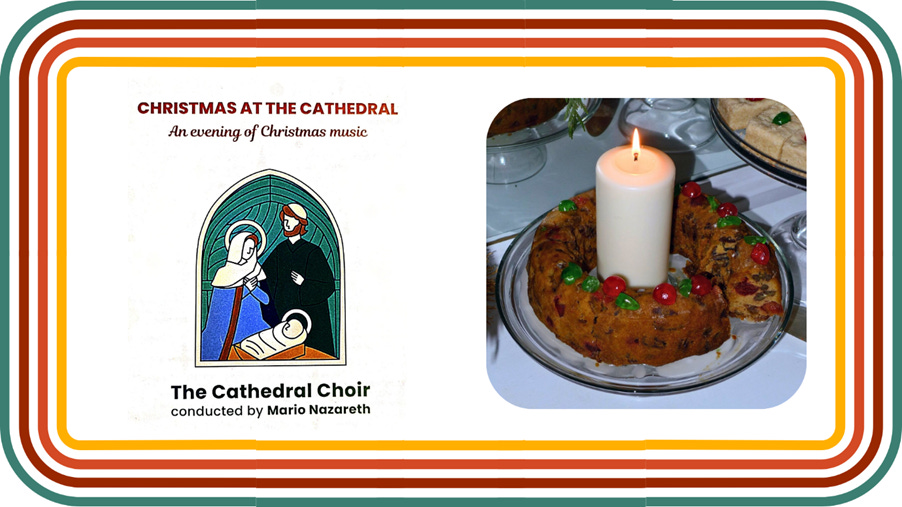
Earlier in the month, we were in the audience of a carol recital by the choir at the Cathedral of the Holy Name, Bombay, that had us wrapped with joy in their SATB formation. The Cathedral Choir was first established in the year 1905, and the 2025 ensemble had people who’ve been part of the choir for over 50 years. Beyond the performance, I was hooked by the accompanying compere for the evening, who was articulate and measured to punctuate the pauses between the carols. She described the evening as a gathering to witness the bridge between traditional compositions and their modern renditions.
Just as we think of traditional methods and modern innovations, the carols have seen a similar curve over centuries—from Latin verses to multilingual translations, from adherence to pure holy scriptures, to commercial popularity with modern-day albums by famous musicians like Bing Crosby, Nat King Cole, Elvis Presley, Mariah Carey, Carrie Underwood, and many more.
Can we script a joyous feeling in advance, or tame a spirit in celebration? That’s a conversation and carol for another day!
Fermenting Festivities
While there’s a grammatical debate around the placement of comma when writing ‘God Rest Ye Merry, Gentlemen’, there’s no debate around how people interpret ‘merry’ while celebrating Christmas. There are songs, devotion and reverence on one side, and feasting and parties on the other. The Christmas cake is at the centre of festivities, and comes with a long and winding history. The folklore began in ancient Rome, where early versions of holiday desserts took shape in the form of dense, sweet loaves mixed with barley mash, pomegranate seeds, nuts, and honey. As we got to the Middle Ages, the Roman cakes gave way to a more decadent plum porridge—a winter dish made of boiled oats, dried fruits, spices, and meats to keep people warm in ghastly, cold temperatures. Over time, the porridge made way for Plum Cakes, thanks to the emergence of sugar and baking methods. The addition of dried fruits, such as raisins and currants, along with spices like cinnamon and nutmeg, introduced layers of flavour that transformed this humble dish into a seasonal delight. The different ingredients have their own significance and diverse interpretations—being grateful for the yield through the year, being hopeful for good fortune and prosperity in the future, a symbol of gifts from faraway lands to the new-born Jesus, and mark of status and ceremonious showcase during celebration and communal gatherings.
Different countries and regions had their own versions of traditional Christmas delicacies—Panettone in Milan, Italy, Stollen in Saxony, Germany, Kurisumasu Keki in Japan. These forms of cakes have won fans the world over. For example, Panettone retails from as less as £6 to over £400 in the UK. Panettone has taken the status of lifestyle gifting, with brands like Dolce and Gabbana baking a fashionable festive cheer.
I went on a global exploration, after reading how the Christmas cake made its way to India. In 1883, a British planter, Murdoch Brown, got the rich Plum Cake from England, and shared it with a local baker for him to bake a similar cake. Mambally Bapu, the Indian baker, used local liquor made from cashew apple and kadalippazham (a type of local banana), in place of yeast or French Brandy. The Kerala Plum Cake is mistaken for the traditional English Plum Cake, but it is a version at best. However, for many taste buds, the Kerala version is divine in its own right. India doesn’t have a long baking tradition, but it has a long-standing generational passing of secret recipes in family kitchens. These traditions take centre stage every December. There are local variations of Christmas cakes cutting across Allahabad, Calcutta, Goa, Pondicherry, and Bombay. The twist is in the ingredients ranging from locally produced marmalade, gourd candy, tutti frutti, coconut milk, Indian spices, roasted semolina, ghee, and much more.
The chronicling of carols and recipes, the human quest to explore and socialize, and the evolution of world trade form the center of the globalization of cultures, innovation of traditional practices, and a healthy exchange of thoughts and ideas. Call it a melting pot of diversity, or the cusp of hope and a happy vibe—no one’s complaining.
Go forth, and spread the cheer.
Listen Up
I know we already have four carols, and we haven’t ever heard of the fifth be a lucky charm, but this one is special. This was the opening piece of the concert put together by The Cathedral Choir in Bombay. Carol of the Bells performed by the St. George’s Chapel Choir. The original composition stems from the early 20th century from a Ukrainian song that the natives looked up to as their New Years’ celebration song. The tune was composed by Mykola Leontovych, and the English lyrics were added by the American composer and choral conductor, Peter Wilhousky in 1936. Here’s the rendition of the original Ukrainian song, Shchedryk
I’m forever on the lookout for tunes old and new, You can check out my expanding Trove Of Tunes that I’m curating in a Spotify playlist.
Cheers,
Shri