
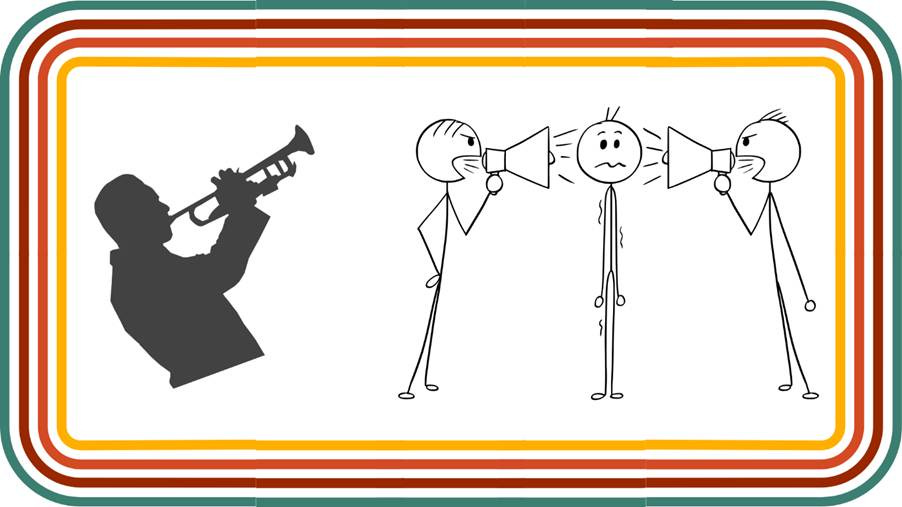
The AI race has spawned a strange chorus. In some hallways, it seems to immerse in nuance, and on some feeds, it’s just raising its volume. Between fear, anxiety, hope, and possibilities, the room for listening to one’s own voice has become a lot more claustrophobic. For this piece, I look at the joy of imperfections and the crossfire of counterpoints clouding our lives. Read on!
The Notes Of Separation
When it comes to music, there are albums that get produced in a studio, and concerts that grace live arenas. Over a period of time, technology has enhanced the sound and light of music production and performance. This has not only led to the sharpening of rough edges, but has also opened up newer ways to reimagine the art—for example, this Irish cover of Michael Jackson’s Billie Jean created by AI.
Over the years, the George Lucases of the AI world have continued to harp on the interplay of AI and humans to advance the path to perfection, with narratives along the lines of humans being the captains, and AI, the copilots. Last week, I was reading this piece by Ted Gioia, one of my favourite commentators on music and culture, where he argues on how the grace of music, and the spirit of musicianship lies in letting the imperfections be. He’s right to the point as improvisations lead to imperfections. It is not being wrong, but it’s letting the spirit of playing with the music, instead of treating it as just another chore. Humans may choose to leverage AI to smoothen the edges, but the listeners’ ears are not seeking the autotune. They’re just reaching out to receive an honest connection.
“If you’re a jazz soloist, your goal isn’t perfection. That’s for machines. Art is expressive of the human condition—and that’s always a messier affair. Miles Davis taught me that even mistakes can make a solo better, not worse.”, Ted Gioia.
Ted appreciates the room for error in music, and rightly disqualifies it as a pure mathematical calculation. Even if there’s a lot of math behind a composition coming together, the production and performance is a sum of heart, talent, and soul. I like this excerpt of his book ‘The Imperfect Art’ that Ted quotes in his piece:
“Imagine a computer that has been programmed to compose musical works in any style. Even if the computer produced works stylistically and qualitatively indistinguishable from Mozart’s, we would still be unwilling to consider them as comparable to the Austrian composer’s pieces. The two are incommensurable. Mozart’s works are artistic masterpieces, and the computer’s output, however admirable, is something else entirely. The latter’s perfection no more reflects on the composer’s art than the existence of motor boats affects our judgment of how difficult it is to swim across the English Channel.”
A few months ago, I used one of the AI apps to turn a couple of my poems into songs. I prompted the genre, voice, tone, and the feel I desired, and let the studio of models work it out. I tried multiple versions, but I wasn’t too happy with the end output. Not an unfamiliar script for the Rick Rubins of the AI world, and something that’s always covered under the banner ‘learning in progress’.
At the end of the day, I think the commercial acceptability of music, or for that matter, any piece of creativity, will be driven by the audience’s consumption habits, which will in turn influence the decisions of the recording companies. Would the listeners be content and convinced with the AI output that will fit the puzzle beautifully one day? Or would they still be tuned to the moments of vulnerability and imperfection, which allows them to appreciate the human nature of the musicians? I’m on the side of the latter, even if I’m a strong advocate of technology, AI, and part of the world of hope it continues to develop.
You Can’t Hear The Voice If You’re Tuned To The Noise
There has been a barrage of content pieces flooding our feeds over the past couple of weeks. It’s as if everyone wanted to get back to high school and write essays, or apply for college with their SOPs. It all started with this piece by Matt Shumer. Matt seems like he’s coming from a good place, readying people outside the tech industry with the reality of what’s happening with the AI civilization, and what one can do to swim alongside. This is not the first piece I’ve read that tackles the themes that Matt has captured here, but I like the lucid and easy-reading style of this one. A cavalry of defence, validation, spoofs, and counterpoints landed post that, maybe hoping for the same degree of viewership that Matt’s piece garnered. I liked one, which had the Mac mini as the centrepiece.
Some called Matt’s piece AI sloth, and maybe some of the counterpoints were sloth too. If you find the slightest of value in a piece, keep it and carry on. If not, send it to the recycle bin. I feel, we waste too much time critiquing and endorsing every perspective on AI we consume, thereby losing time towards deep work, and having a single-minded focus on getting better ourselves, and with our output.
As humans, we’re so consumed by the state of AI singularity, that we forget the singularity of the human mind to expand its realms of achievement by partnering with technology. Just like Matt’s piece, another milestone hit us between Feb 16 and Feb 20, 2026, in New Delhi, India—The India AI Impact Summit—one of the largest gathering of thinkers, shapers, doers,, orchestraters and consumers of AI. There were talks, promises, pitches, and bold visions, spun with the same vocabulary, language, stakeholders, but with a far higher bravado. Everyone jumped into the arena, because of FOMO IRL, and you could be called out if you were not in the huddle. However, the question is if one managed to walk out with clarity and an action plan of what one needs to do. Or was it just another large fishing expedition with wide nets, some good catch that made it to dinner, but the rest washed away to swim the same way for another day?
Whether AI is coming for me, with me, or behind me, I’m clear that I personally need to put in my time to understand the technology, understand my line of work and interest, and bring the two worlds together in a way that makes sense for me. While doing this, there’ll be things I don’t know enough about, and things that I don’t know just yet. These are the imperfections I’m perfectly happy to be in harmony with. So, I’ll still listen and cheer a musician improvising in service of their craft—missing a note here and losing a scale there. I’ll still read pieces similar to Matt’s and stay away from noisy gatherings. I choose what makes sense to me, and that’s my Take Five.
Listen Up
Take Five by the Dave Brubeck Quartet from their 1959 album ‘Time Out’. One of the greatest and most recognizable jazz classics of all time with a fantastic melody and rhythm section.
I’m forever on the lookout for tunes old and new, You can check out my expanding Trove Of Tunes that I’m curating in a Spotify playlist.
Cheers,
Shri