
This piece was first posted for my LinkedIn Newsletter, here, and has been reproduced below with minor edits.
England seems to have a thing for coronations in the month of May—Henry III in 1220, George VI in 1937, and Charles III in 2023. In 2026, through a little creative liberty, I’ll add Sir David Attenborough’s hundredth birthday, and the Arsenal Football Club’s 2025-26 English Premier League (EPL) championship win to the list.
Read on!
Nature Breathes Through Him
The radio industry of any year and decade would disagree with the BBC, but the BBC of 1950 didn’t think Sir David Attenborough’s voice was best suited for the radio. He took his business to the world of television, and hosted his first gig in 1954 from West Africa, as a presenter of Zoo Quest. It’s 72 years and counting, and he’s the longest-serving television presenter alive in the history of television broadcasting.
Sir David grew up wandering the corridors of a zoology department. At eleven, he ran a small business: catching newts from a pond five meters from the zoology lab and selling them back to the lab at three pence each. The department never quite worked out where their supplier was getting his stock. He cycled for miles to quarries to collect fossils.
He rose in the ranks within the BBC, but his purpose was larger and not tied to the commercial pursuits. He holds 32 honorary degrees, but if there’s one thing we can observe from his works, it’s his constant focus on leveraging all his knowledge to make the world a little wiser.
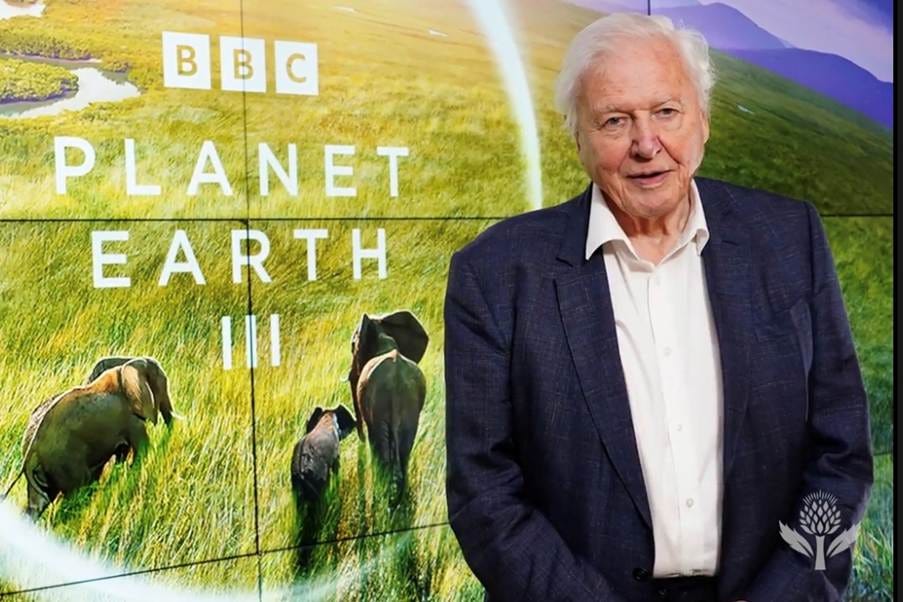
His 1979 series ‘Life on Earth’ was watched by an estimated 500 million people—roughly one in nine humans alive at the time. In 2017, 80 million people in China streamed ‘Blue Planet II’ simultaneously, slowing down the country’s internet. In 2025, his cinema film ‘Ocean’ became the highest-grossing nature documentary of the decade. He has been on television longer than the medium of streaming has existed, longer than most of his viewers’ parents have been alive, and the numbers only continue to rise across demographics, households, and the world over. Off camera, and beyond the genuine public admiration, there are two aspects of Sir David that draw out an authentic human connection:
· The arc of purpose: His mission was education, his medium was television, his subject was nature, and his route was storytelling. He never broke away from these four pillars, and worked to keep simplifying them to connect with every demographic of the audience. This sums up his resolve over the years: ‘We need to work with nature, not against it.’
· A punch of pause: I always feel, the true mark of any broadcaster is the ability to pause—for effect, impact, and creating space to be heard. It’s not always about the best questions, not about the most thorough research, not about the compelling monologue. It’s a conversation that’s well-poised, adequately paused on both ends, in order to be heard, felt, and remembered. This ability of striking a balance between pause and prose is not just limited to human conversations. It extends to the conversation between humans and nature, our noisy thoughts and the crashing waves in the sea, our silent murmurs and the eeriness of the breathing trees in the still of the night.
People have written essays about Sir David’s voice. He keeps his voice quiet so that nature can speak first. The hush is a gesture of respect. He and his crew are just visiting guests, and discipline is everything. He understands that nature footage needs space to breathe, that the silence after a sentence often does more work than the sentence itself. When he finally raises his voice, when a chick fledges, when an elephant takes a water break, the lift in his tone feels like the planet exhaling.
He celebrated his hundredth birthday on May 8, 2026, took in all the messages from across the world, and got back to work. There’s so much to be done, and he’s making every moment count. This quote by him sums up the current state and our expected role: ‘The fact is that no species has ever had such wholesale control over everything on Earth, living or dead, as we now have. That lays upon us, whether we like it or not, an awesome responsibility.’
140 Years of History, And The Glory Returns After 22 Years
On May 19, 2026, a young eight-year-old went ‘We are champions, Daddy’ to his father, who was heating the grill for his family. The father was the manager of the Arsenal Football Club, Mikel Arteta, and it was his eldest son, Gabriel, who set the emotions of the win rolling. The Arsenal Football Club won the English Premier League on May 19, 2026 after 22 years, and more importantly, after three consecutive years of coming close as runners-up.
The Arsenal Football Club was founded in October 1886 by sixteen workers at the Royal Arsenal munitions factory in Woolwich, south-east London. The Scotsman David Danskin put in three shillings of seed money; everyone else put in sixpence each. They named themselves Dial Square after a workshop at the heart of the Arsenal complex, then quickly became Royal Arsenal, then Woolwich Arsenal. In 1913, they moved from the South of London to the North, and retained only ‘Arsenal’ in the name. The move across the river to Highbury saw a lot of angst amongst football fans across England, but soon came World War I, and there were bigger worries to manage.
‘Hard work’ is in the club’s DNA. Call it an inheritance from their factory upbringing. Club football is not just a championship consisting of many games. It’s a combination of commercial gains, fan sentiments, content viability, off-field drama, and on-field performance. I started following Arsenal in their 2003-04 season, not because they were crowned the Invincibles, but because that was the year I started understanding the concept of club football, the composition of a season, and the interplay of the league with the regional competitions. There was something so simple, and easy to love about Arsenal. I’m not someone who wears the facts and fandom on my tongue and sleeve, but it’s an eternal emotion to me.
For the past week, I’ve been scrolling through my X (formerly Twitter) feed, and the number of stories that are being shared are testimony to what a sense of belonging can do. For example, a father used the Arsenal game against Manchester United in 2025 as a window to restore sanity during one of the toughest times of his life. Two strangers connected over their common love for the game, and showed up game after game for years, and chatted over the good times and losses—one of them is missed during this year’s celebrations. For the past few years, right after Christmas, silence would set in. Watching the team battle the EPL standings, FA Cup ties, and Champions League knockouts between February and April would be a period of quiet discomfort. 2026 was no different, but the morning of May 20th had me exhale with quiet pride and validation of faith.
Work Compounds
Sir David didn’t become Sir David in one documentary. He became the most trusted voice on Earth by spending seventy-two years showing up in jungles, in submersibles, in editing suites, in his hushed studio. He built our relationship with the planet one whisper at a time. Arsenal players and fans didn’t become champions in a moment either. They have been showing up for the same fixture—same scarf, same pub, same seat, for years that have included births, deaths, job losses, divorces, and many life moments.
Nature programmes and football clubs are both, in their best moments, machines for human connection. Sir David has been telling us, in that famous half-whisper, that the planet is not a backdrop. It is the thing we are part of. Arsenal fans have been showing us, with a kind of stubborn weekly devotion, that sport is not really about the score. It is about who you are sitting next to. Whose hand you grab when the ball goes in. Whose name you say first when it goes wrong.
Listen Up
This one got me emotional multiple times in the span of six minutes. Thank You Arteta by Rihanna.
You can check out my growing Trove Of Tunes—a curated Spotify playlist, here.
Cheers,
Shri