
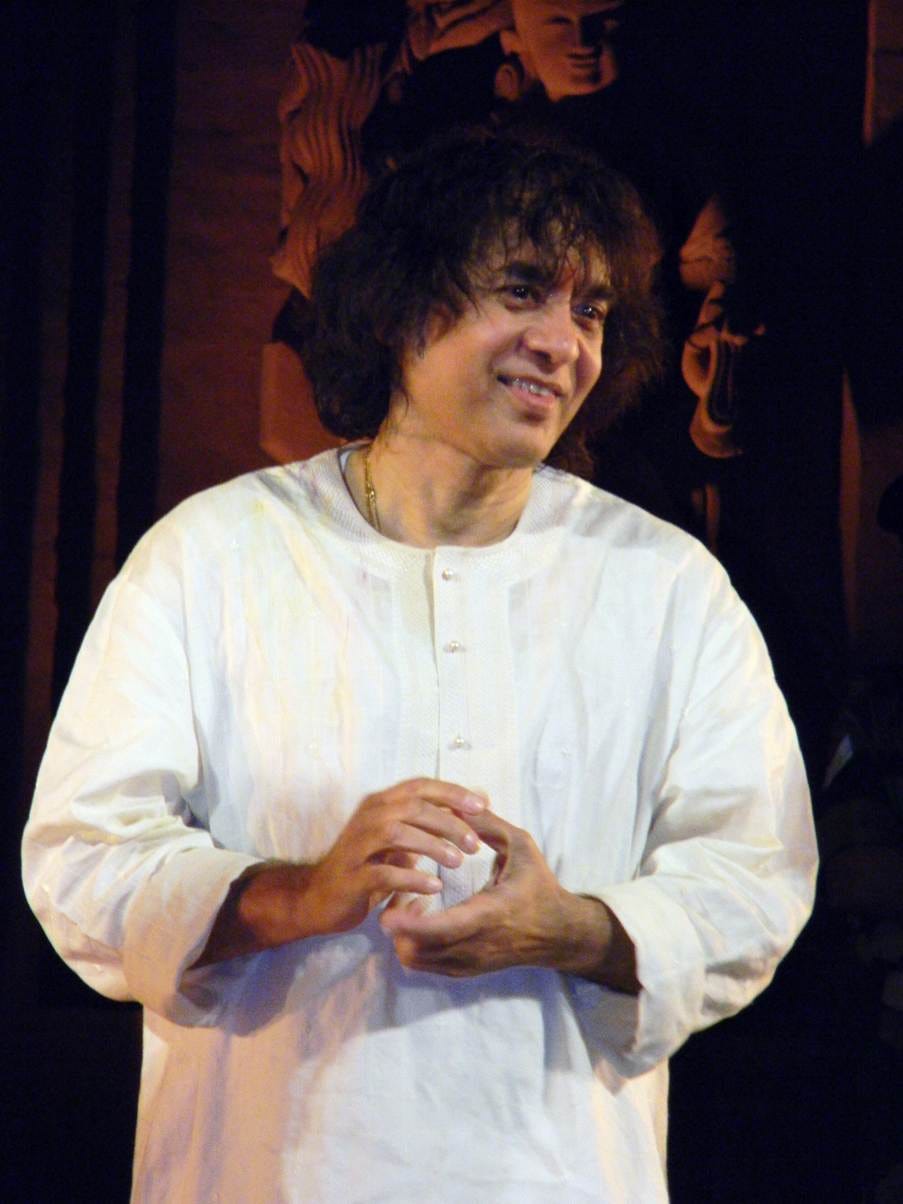
It’s been a year now, but loss doesn’t keep time, and time doesn’t understand loss. They orbit in their own circles, leaving the humans at the center of it. Sometimes loss hits you like pauses marked by three quarters of a beat twice over in a Tihai, or it’s a never-ending Chakradar for the rest of your life. With Zakir Bhai’s passing on December 15, 2024, it’s going to be the latter for me, and a lot of his fans, students and musical brotherhood across the world. When I first heard about his passing, it was a fleeting forward on a WhatsApp group. I messaged my brother, and he pointed me to a conversation thread on Twitter that was still calling out him being in a critical state, and asking people to create a web of faith and prayers, versus fearing the worst. I went off to sleep, hoping the doctors would play the vilambit taal to perfection till the morning, and when they reach the Sum, the faith will revive his life, and the morning will continue with its rhythmic routine. But we lost the beat that day!
I wrote this piece earlier this year, about six weeks after his passing, and have tried to make sense of it to myself, on the eve of his first death anniversary. When I look at the joy of sharing, and the feeling of a loss beyond any diction, there’s one thing common—they never fade away from one’s memory. But memory is a great healer too. It makes the happy residue from the living days crash into the thoughts of the missing present, thereby creating a ripple of deep reverence.
First Impressions
I was amongst the many who was captivated by the Brooke Bond Taj Mahal Tea ad from yesteryear. For its simplicity, the short composition, and my earliest exposure of solo head banging. But it wasn’t just the shake of the head to the rhythm, but the swirl of the hair—magnificent capture in a frame. The ad could have been one of the factors influencing my interest to learn a percussion instrument back in the day. Tins of Complan and Protinex gave way to Tabla, which stayed with me for years. One of the fascinating parts of my learning journey was the number of stories involving Zakir Bhai from my then Tabla Guru—From Zakir Bhai’s quest to explore music of different genres, cultures and origins, to his reverence to the stage and every artist, old and young. Part of one such hearsay was when Pundit Vijay Ghate was on stage, playing the Pancham Sawari Taal, and Zakir Bhai walks into the greenroom with complete awe and was wondering how he’s going to follow the act, given he was also thinking of playing the Pancham Sawari that evening. One of my first records of his was Ecstasy, a jugalbandi with Abbaji – his father, Ustad Allarakha Khan. Keeping time to the compositions was on one side, but I’d always keep my ear out to catch the synchronous landing of the bols Din, Thin and Thun.
The Joy of Expression
It was a Saturday evening in the January of 2001/02 when I caught his first ever live concert, where he was playing with Remember Shakti on the lawns of the Gateway of India, Bombay. It was our first Zakir Bhai concert as a family, and possibly the first-ever concert ever in attendance as a family quartet. There was probably 1 more Shakti concert we had the opportunity to attend years later, but more importantly that concert in January of 2001/02 opened us up to seek, listen and appreciate cross-genre collaborations and influences from different decades in time.
One of the biggest series of concerts we’ve attended over the years, was the Barsi celebration for Abbaji—Ustad Allarakha Khan put together by Zakir Bhai and his brothers. The concert was always free, and understandably so, it’d be too difficult to get the passes. As soon as we would get to the last week of January, the only thing that mattered was getting those passes for the concert on Feb 3rd every year. We got to listen to a rich tapestry of artists from across the world while celebrating this day-long homage to Abbaji, ranging from Leonard Eto, Steve Smith, Sivamani, Trilok Gurtu, T. K. Murthy, T G Muthukumarasamy, George Brooks, John Mclaughlin, Kawa Brass Band, Ustad Rashid Khan, Ajoy Chakrabarty and many more.
Reverence and Grace
I’ve always called him ‘Zakir Bhai’ while conversing about him in third person. I’m not related to him, even with the 6 degrees of separation, nor we’ve learnt from the same guru to call him ‘Bhai’ (brother in Hindi). But there’s this inexplicable connection that we have, through his records and performances that refuses to have me speak of him in distance by calling him ‘Ustad Zakir Hussain’, or on the other hand surrender all respect to casual speak by referring to him as ‘Zakir Hussain’. Calling him ‘Bhai’ is no way to come across as a dear connection, or a musical connoisseur. It’s just a humble association through art that we were blessed to partake in his presence.
When I think of music, it dawns different hats—an agent of peace; a stimulant of energy; a gathering of diverse cultures; an inclusive stage that’s bigger and richer than our individual selves. And Zakir Bhai would continue to be its son, advocate and Masaya. It’s not just the kind and stature of artists he’s accompanied over the years, but the thing that will continue to stay with me is the combination of respect and mischief he’d have with other artists on the stage. His smile would light up every interview, stage interaction, and for that matter, every opportunity to connect with a viewer or a listener. One could feel his warmth and respect when he’d introduce his fellow artists on stage like when he would cheer and introduce U Srinivas as ‘The Mandolin Maestro’ and Shankar Mahadevan as ‘The Voice’ during their Remember Shakti concerts.
Today, as I continue to attend concerts by artists who have played with him over the years, I leave one year on the stage, and let the other drift into a wistful hope for what will never be. The stage will miss one of its chief celebrants in service. Maybe he’s got the best seat in the house to watch the prayer in motion, from the queues outside the hall, the greenroom, the stage, and the audience, all at the same time. The rhythm will continue just like time; it’ll reverberate and echo; it’ll heal and cheer; it’ll keep on, many encores over. But rhythm, unlike time, can slow down and accelerate, and emote with grace. And every one of those emotions lit up by a percussion instrument across the world has the handprint of the faithful servant of rhythm, Zakir Bhai—Ustad Zakir Hussain.
Listen Up
There are compositions, albums, collaborations and live performances that will continue to be played in full lengths and on Instagram reels, catering to the trend of the times. From traditional to popular, from evergreen melodies to forever treasure; here are a handful of them for your listening pleasure.
Zakir, a composition by Zakir Bhai’s dear friend of 55 years and counting, John McLaughlin. This featured in his 1986 album—Making Music.
Jig O’ Beer & Chai from the 2015 release—Distant Kin, featuring a host of global artists.
I’m forever in the lookout for tunes and melodies old and new. You can continue to check out my Trove Of Tunes curated in a Spotify playlist by clicking here.
Cheers,
Shri